

Decentralized, encrypted, and completely private messages. That’s what Session promises.
You may never have heard of the app, but for its 1.7 million monthly users, Session is an important piece of privacy tech worth fighting to sustain.
Due to a severe funding shortfall, Session was expected to cease operations this week. However, after securing $200,000 to keep the project afloat, the team is now ready to look ahead.
Session co-founder Chris McCabe described the app as a “critical tool for fighting against an Orwellian future.” But what is Session, and what does it offer that mainstream giants like Signal can’t?
How Session survived its financial crisis
Launched in 2018, the project originally sustained its decentralized infrastructure through its own crypto tokens. According to McCabe, the Session Technology Foundation (STF) sold roughly $2.4 million worth of tokens toward the end of 2024 to keep the project going.
However, the model wasn’t sustainable and, when a crisis in the crypto market drained Session’s finances last year, the founders were forced to terminate the contracts of all 16 of their team members.
Unwilling to let the platform die, the founders scrambled for alternative lifelines. Following a high-profile emergency donation from Ethereum co-founder Vitalik Buterin — who gifted 128 ETH to support the app’s mission — the foundation decided it was time to turn to its user base for long-term survival.
Without additional funding, Session’s doors will close next month. Please read this appeal from Session co-founder Chris McCabe.https://t.co/nTJCocoDwIMarch 19, 2026
That grassroots fundraising campaign ultimately paid off.
To date, Session has received hundreds of community donations totaling $205,000. While that is still a long way off the project’s ultimate $1 million sustainability goal, it is enough to keep the platform operational, albeit with far fewer resources than it once had.
“This funding allows us to retain three developers and one community operations person to maintain the app,” McCabe explains.
How Session protects your messages
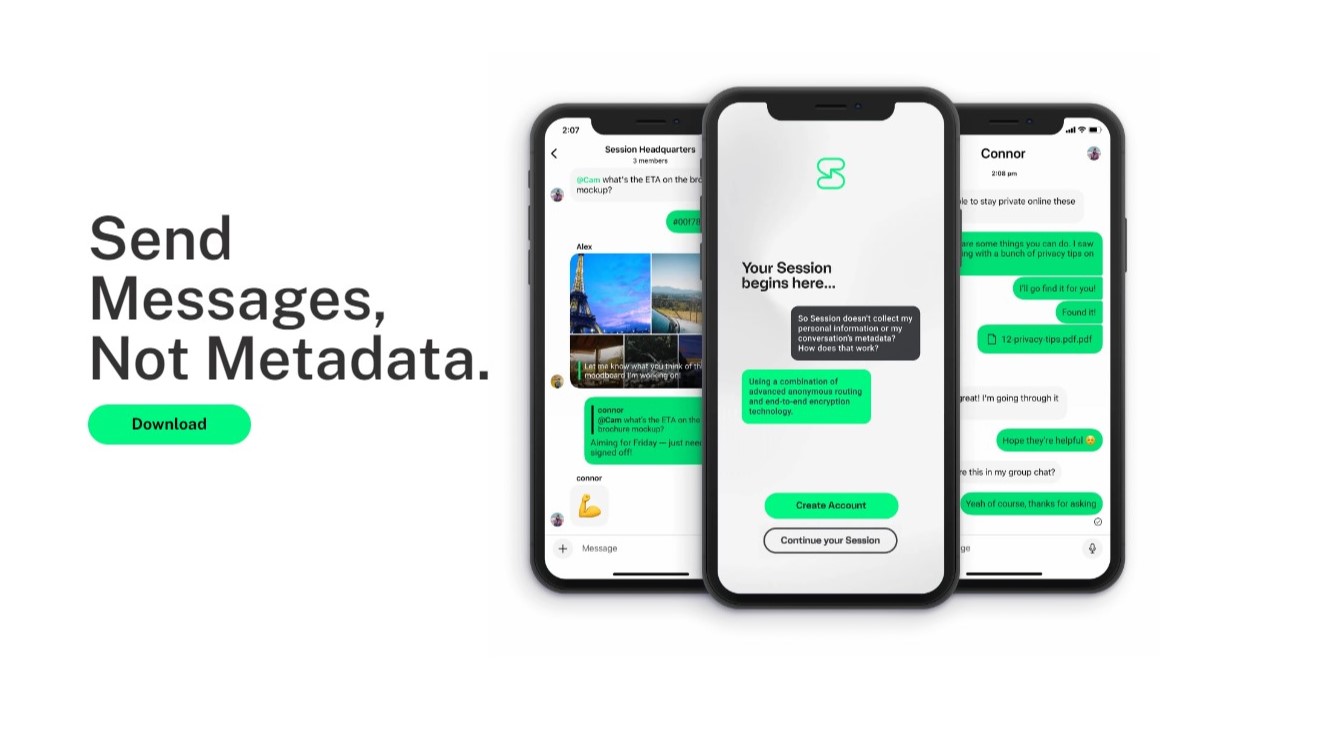
“Send messages, not metadata” is Session’s mantra. To back this up, the app uses a variety of advanced techniques to ensure users’ messages remain private and secure.
From basics like end-to-end encryption to the use of a decentralized infrastructure and onion routing, Session goes significantly further than mainstream messaging apps.
“Session is completely trustless,” McCabe told TechRadar. “You don’t even have to trust us because the open-source code guarantees your security.”
In the future, the app’s design should also make it less vulnerable to increased surveillance and monitoring, such as the initiatives currently being proposed in Canada, the EU, and the UK.

In October 2024, the platform’s creators shifted operations to Europe to help protect users’ privacy. The move allowed the team to escape an Australian legal landscape that the founder described as “increasingly hostile” toward encrypted apps, relocating to the traditionally privacy-friendly jurisdiction of Switzerland.
Because the platform is open source, McCabe claimed the app can continue to operate even in countries where it has been banned from mainstream app stores, noting that users can easily bypass those restrictions by sideloading the app on Android devices.
And what happens if a repressive government demands data about an individual user? McCabe noted that the foundation simply couldn’t comply, saying: “It’s technically impossible for our company to copy or store that data.”
Crucially, users do not need a phone number or email address to sign up for the service. That anonymity is especially beneficial for citizens in conflict zones or highly restrictive digital environments, where hostile governments can block SMS two-factor authentication messages to cut off access to mainstream messaging networks.
So, how exactly does Session stack up against mainstream giants like Signal?
Is Session really better than Signal?

Signal is widely recognized as the gold standard for privacy-preserving messaging apps. Like Session, it is fully open-source, collects minimal metadata, and uses advanced end-to-end encryption via the Signal Protocol.
While McCabe agrees that “Signal is great,” he believes that being completely decentralized and eliminating the need for a phone number tips the scales in Session’s favor.
However, not everyone in the cybersecurity community shares this view.
A prominent cryptanalyst who uses the pseudonym Soatok has publicly argued against switching from Signal to Session. A major point of criticism is Session’s decision to remove Perfect Forward Secrecy (PFS) — an important security feature that ensures that past chats remain private even if a user’s long-term identity keys are compromised in the future. Soatok also suggested that Session contained several other cryptographic flaws and implementation mistakes.
Bill Budington, Senior Staff Technologist at the Electronic Frontier Foundation (EFF), backed Soatok’s analysis, telling TechRadar that Session appears to be another aspiring Signal competitor that “comes up lacking on its security claims.”
Mohammed Al-Maskati, the Digital Security Helpline Director at Access Now, shared this concern. He argued that sticking with a widely implemented standard like the Signal Protocol is generally a safer option because it significantly reduces the risk of making critical errors during development.
Responding to these critics, McCabe explained that while Session initially relied on the Signal Protocol, the team was forced to build its own encryption method because Signal’s architecture wasn’t designed to handle a decentralized node network.
However, he confirmed that PFS is officially slated to be reintegrated into the platform with the upcoming Session Protocol V2 upgrade.
Security experts have also pointed out that Signal remains a stronger choice for most users due to the sheer size of its network, which makes it far easier to use with friends and contacts.
However, McCabe rejects the idea that popularity equates to security, arguing that by that logic, WhatsApp would be considered a better privacy option than Signal. “Which it is not,” he said.
What’s next for Session?
As Session prepares to enter its next phase, the foundation is focused on achieving long-term financial sustainability.
To generate steady revenue, the platform plans to launch a premium subscription tier called Session Pro. Similar to Telegram Premium, Session Pro will offer power users advanced features — such as higher message character limits, expanded group sizes, more pinned chats, and animated profile pictures — backed by cryptographic proofs that preserve user anonymity during payment.
Most pressing, however, is finalizing Session’s Protocol V2. Beyond reintroducing Perfect Forward Secrecy (PFS), it will also introduce post-quantum cryptography to secure users’ chats against ‘harvest now, decrypt later’ threats.
While the wider InfoSec community continues to be divided on whether Session’s custom architecture outperforms legacy rivals, the core team remains fiercely dedicated to the project.
“Many former team members are incredibly passionate and are taking pay cuts or donating their time to help get it back together,” said McCabe.
And with mandatory age verification, lawful access to data, and encryption backdoors challenging the very notion of online privacy globally, it seems that messaging app like Session are going to become increasingly important.
As McCabe puts it: “People often don’t realize they need this level of privacy until things go really badly and freedom of speech is restricted.”
If you want to support the platform, Session continues to accept donations directly through its official website and mobile application.
![[Aggregator] Downloaded image for imported item #154854](https://kcmicro.com/wp-content/uploads/2026/07/WK7mbpSZ5TPfRHUyAAr4u3-1280-80-800x500.jpg "[Aggregator] Downloaded image for imported item #154854")
![[Aggregator] Downloaded image for imported item #154857](https://kcmicro.com/wp-content/uploads/2026/07/XCpnp9fvBTvayHb7nJSSsT-1280-80-800x500.png "[Aggregator] Downloaded image for imported item #154857")
![[Aggregator] Downloaded image for imported item #154821](https://kcmicro.com/wp-content/uploads/2026/07/p2uWFBGHtrHTjrYSDny87M-1280-80-800x500.jpg "[Aggregator] Downloaded image for imported item #154821")