


- Surfshark recorded nearly 6 times as many malware detections on Windows
- While trojans mostly target Windows devices, phishing lands harder on Mac
- A “Macs are safe” mindset may leave users more at risk of social engineering
New data from Surfshark shows a stark split in how malware finds its targets: Windows users are hit at nearly six times the rate of macOS users.
The headline number is eye-catching, but the full story is more interesting. While Windows soaks up the vast majority of traditional malware, Mac users face a very different kind of threat, one that a locked-down operating system does little to stop: phishing.
Antivirus software paired with one of the best VPN services remains a sensible layer of defence, whatever you run, but Surfshark’s findings are a useful reminder that while risks change depending on the platform, they never disappear.

Surfshark – the best cheap VPN
Surfshark is a fast, easy-to-use VPN that seriously beats the competition when it comes to subscription pricing. Its two-year Starter plan works out at $2.49 a month (plus tax), but we think Surfshark One is the best value plan as it adds an antivirus, data breach monitor, and alternative ID tool starting from the equivalent of $2.79 a month. View Deal
The six-times gap, by the numbers
Surfshark analysed 391,305 malware detections logged by its antivirus between 1 January and 31 July 2026. Windows devices made up 66% of the active user base but accounted for a striking 92% of all detections, while macOS users represented 34% of the base yet just 8% of threats.
That works out to nearly six Windows detections for every one on a Mac.
“Windows’ popularity has always made it the biggest target for cybercriminals,” said Gabrielė Sinkevičiūtė, Head of Product at Surfshark, pointing to the scale of malware built around Windows’ dominant market share, along with differences in how each platform handles third-party software and permissions.
Surfshark’s equivalent research from last year yielded similar results, so the trend appears to be consistent.
Trojans dominate Windows, while phishing surges on Mac
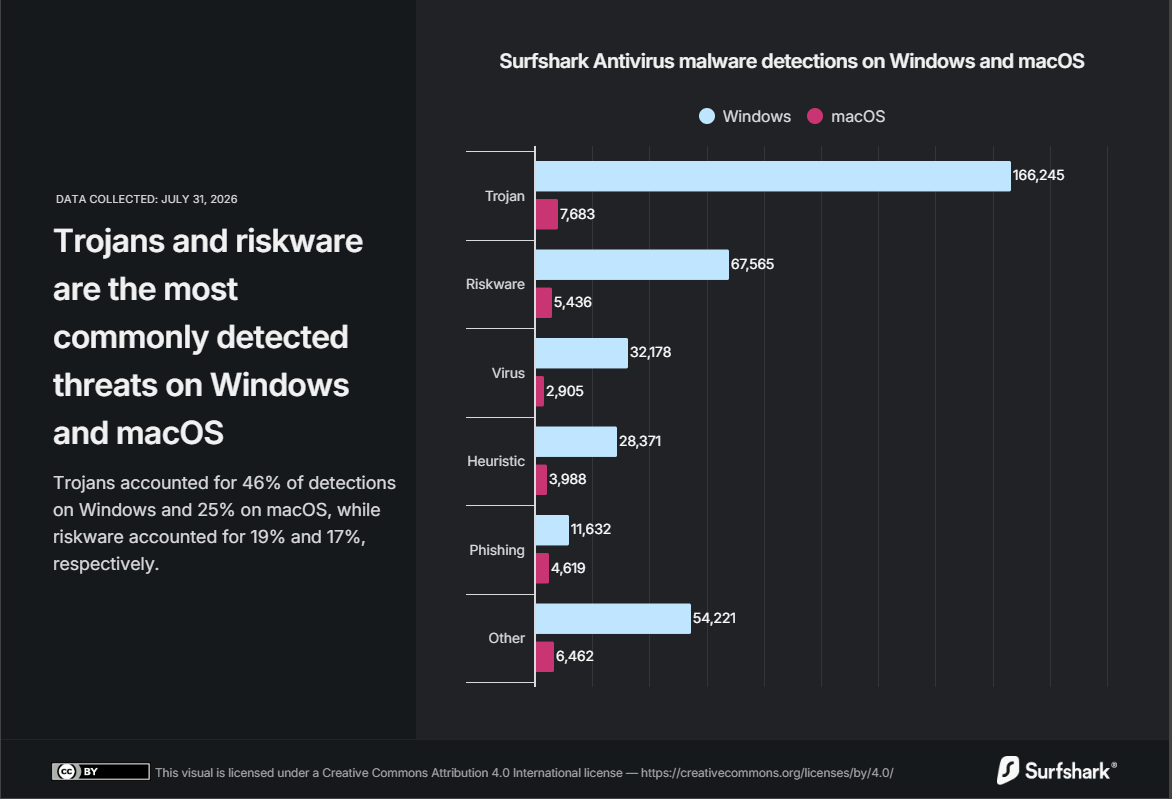
The threat mix differs sharply by platform. Trojans (malicious software hiding inside safe programs) were the top danger on Windows at 46% of detections, versus 25% on macOS, while riskware (legitimate software that can pose security threats) sat at 19% and 17% respectively. Viruses were level at 9% on both, and adware (software that puts unwanted ads on your device) trailed at 4% on Windows and 3% on Mac.
Phishing is where Mac users lose ground. It ranked third on macOS at 15% of detections, but only sixth on Windows at 3%. Because phishing exploits trust rather than software flaws, a hardened operating system offers little protection, and Surfshark argues a false sense of security can make Mac owners slower to question a suspicious message.
Other research backs this up. Microsoft reported in early 2026 that infostealer campaigns are expanding beyond Windows onto macOS using social-engineering tricks such as ClickFix prompts and fake installers, and Malwarebytes has tracked Mac infostealers becoming a mainstream threat rather than a rarity. TechRadar has likewise reported that the “mythical” security status of macOS is fading.
How to stay safe
The core advice is the same on both platforms: treat unexpected links, attachments and login prompts with suspicion, keep your operating system and apps patched, and only install software from official sources.
Never paste a command into Terminal or PowerShell because a website told you to, as that single step drives many recent Mac infections.
Running reputable antivirus software helps on either system, but the biggest fix for Mac users may be a change in attitude. Dropping the assumption that Apple hardware is inherently immune is the first real step toward not becoming the softer target.
![[Aggregator] Downloaded image for imported item #167439](https://kcmicro.com/wp-content/uploads/2026/08/Security_CBPWorkersAllegedlyUsedSensitiveGovernment.gif "[Aggregator] Downloaded image for imported item #167439")
![[Aggregator] Downloaded image for imported item #167434](https://kcmicro.com/wp-content/uploads/2026/08/EXMLBYo5k7EwcuyYg9vmmM-1280-80-800x500.jpg "[Aggregator] Downloaded image for imported item #167434")
![[Aggregator] Downloaded image for imported item #135619](https://kcmicro.com/wp-content/uploads/2026/05/9WT9t3hZhDVD84bF8rSypL-1280-80-800x500.jpg "[Aggregator] Downloaded image for imported item #135619")